
I confess to being a Metaphysical junkie, absorbing all sorts of ‘out there’ kind of stuff. While that focus isn’t always welcome, and easily dismissed because I’m a woman, I remain optimistic that eventually, more people will embrace the deeper wisdom of Astrology, Tarot, Human Design ~ the Oracular Sciences. given the rich symbolic lexicon that the depth of the soul reverberates with here, I believe these ‘arts’ can help move humanity forward in a way science cannot. Now that I’ve opened up that can of worms, I’m making a pivot to focus on one of these Oracular Art forms… the Tarot.
When first exposed to Tarot cards in my 20’s, (1980’s), I was captivated. Alongside the classic Rider/Waite/Smith and Aleister Crowley (Thoth) decks, I owned the round ‘feminist’ Tarot deck, Motherpeace, which drew upon goddess and indigenous cultural myth and literature. Since then, Tarot has become (more) mainstream, but like so many other metaphysical phenomena, taken seriously only by a marginalized segment of a society. For me, Tarot has been an essential tool in my kit for navigating life; over the years, it’s helped me understand the subtler forces in my life, and guided me out of confusion. Fundamentally, it pushes ego viewpoint out, in favor of an archetypal, synchronistic interpretation.
The Tarot is made of 78 cards, 22 Major Arcana (0 à21) and 56 Minor Arcana (4 suits of 13 cards ~ Ace à10 + 4 court cards, like a regular card deck). The Major Arcana represents a person’s journey through life, from the innocent, fearless ‘0 Fool’, through the last card ‘21 The World’. Ups and downs, outward and inward, they represent the convoluted mystery of the human journey. The major arcana has more staying power in a ‘reading’ than the minor arcana, but any advice sought, reveals nuanced information to consider. Often it is goose bump correct in its insights.
As an artist, I’ve toyed with the concept of making my own deck, but have always felt daunted by the task. But recently, in the midst of playing with new imagery, and methods of working, I ended up with an artwork that looked like The Chariot.
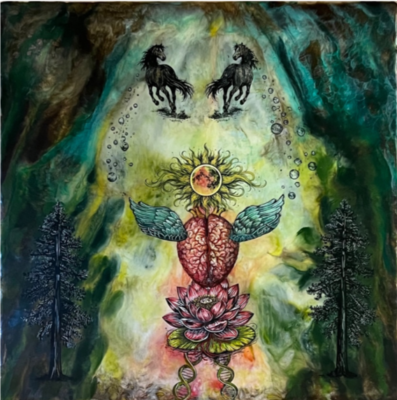 Title: The Chariot
Size: 14” h x 14” w x 1.5″ d
Price:$235 Date: 2026
Media: Encaustic & Mixed Media (image transfers, oil paints) on cradled Panel board
In tarot, The Chariot signifies movement towards (a) desired goal(s). Understanding we live in duality, this means harnessing the polar energies with willpower to achieve forward momentum, through self-control.
As number 7 of 22 major arcana, it represents the ability to overcome obstacles, and stay balanced amidst opposing forces.
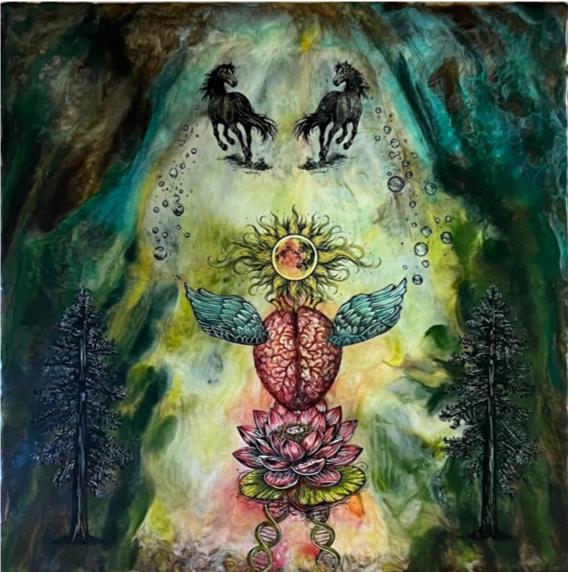
The composite Being (Sun head, heart-brain upper body, wing arms, lotus pelvis, DNA legs) orchestrates the horses through energetic orbs that emerge from the wing tips, and travel through the ethers to the horses’ necks. The horses look back, ensuring the connection to their guide; she navigates through a light-filled passage, a portal of unknown experience. Flanked by trees that ground them to the Earth plane, she no longer needs the physical vehicle (chariot) or the reins – the orbs/bubbles suggest a more telepathic connection between charioteer and her horse power.
The archetypal meaning of this card is to suggest that life is moving along, and we move with grace, ease and make the intended progress through mastering one’s inner emotions, attitudes and applying intention, strategy and perseverance through time.
This piece of artwork has two major influences. The Tarot taps into the metaphysical realm of symbolic wisdom, portraying the archetypal journey every human is on.
The other inspiration came from a unique artist of the High Renaissance, Giuseppe Arcimboldo 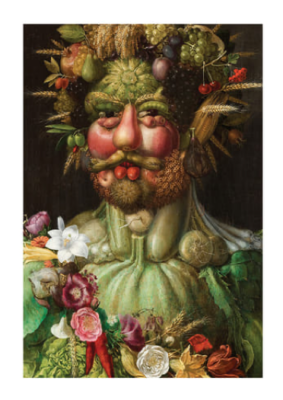 (1527 to 1593). This Italian artist is best known for his imaginative, composite portraits; human faces and bodies are formed entirely from arrangements of fruits, vegetables, flowers, fish, books, and animals. We can call him the first Surrealist. I’ve always been enchanted and impressed by his vision, both whimsical and sophisticated allegories that reflected the Habsburg Empires’ wealth, power and the Renaissance fascination with natural history and emblem books. His work was an influence for the prominent Surrealist movement in the last century.
Vertumnus (c. 1590), a portrait of Emperor Rudolf II disguised as the Roman god of seasons, composed of a lavish array of fruits and vegetables. It is amazing to me how artists of the royalty had the freedom of expression in the 1500’s. In fact, the imagery was enthusiastically embraced as sophisticated intellectual puzzles and political propaganda. The Emperor interpreted the harmonious coexistence of disparate plants and animals in the paintings as a symbol of the peace and prosperity of his reign. The works suggested that his empire was a microcosm of the universe, eternal like the cycle of the seasons.
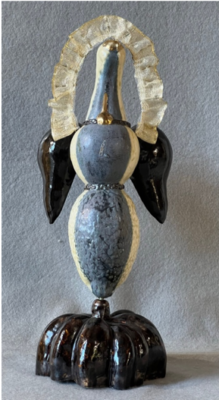 When I was deep into creating ceramic sculptures, I made many fruit and vegetable plaster molds, and slip cast these parts. I then played with combining them to form various plausible forms, including an entire series of ‘Angels’. Giuseppe Arcimboldo’s influence was present here as well. An underlying truth I try to visualize, is the interconnection between humans and nature, the macrocosm and microcosm. It’s always been fun to explore the endless ways of doing this.
Do you recognize the components of the angel here? There are 5 different fruits and vegetables.
Coming full circle, back to the Tarot… It’s doubtful I’ll ever do 78 pieces to create my own Tarot deck. There exists a brilliant array of them out there, and they’re expanding exponentially. Perhaps an Oracle deck, yet another way to tap into intuition, cosmic intelligence, and the mystery. But for now, I am just following my ongoing inner prompts, those that arise from the depths. Life is a mystery, and I am content to not know the future… just to participate in a way that brings more cohesion between humans, and humans with nature… all that is.
Much love to you – and hoping you are managing to go with the flow, with ease and grace in your heart.